The content below is provided for informational purposes only. It does not constitute legal advice, nor does it establish any attorney-client relationship. Please consult with a lawyer regarding your specific situation. While we will try to keep this page updated as much as our capacity allows, the accuracy, completeness, adequacy or currency of this content is not guaranteed.
Everyone in the U.S. has rights, no matter where they are from or their immigration status. These rights are in the U.S. Constitution, which helps protect us from unfair treatment by the police or government. It’s important to know your rights, like the right to stay quiet, the right to talk to a lawyer, and what to do if the police or immigration agents come to your home or stop you on the street.
In case of an immigration raid, detention or attempted arrest:
Remain calm and think before you talk or act.
You have the Constitutional right not to answer questions about your legal status, where you were born, or how you came to the U.S. You can tell the officer, “I have the right to remain silent.”
You have the right to talk to a lawyer before you answer any questions. You can tell the officer, “I want to speak to a lawyer first.”
You have the Constitutional right to refuse a search of you or your home. If they come to your house, they need a “warrant,” which is a papersigned by a judge. You have the right not to open your door without first seeing the warrant through your peephole or under the door. You do not have to let them in without a valid warrant.
You have the right not to sign anything you don’t understand and wait until you talk to a lawyer. Don’t let anyone make you sign papers out of fear.
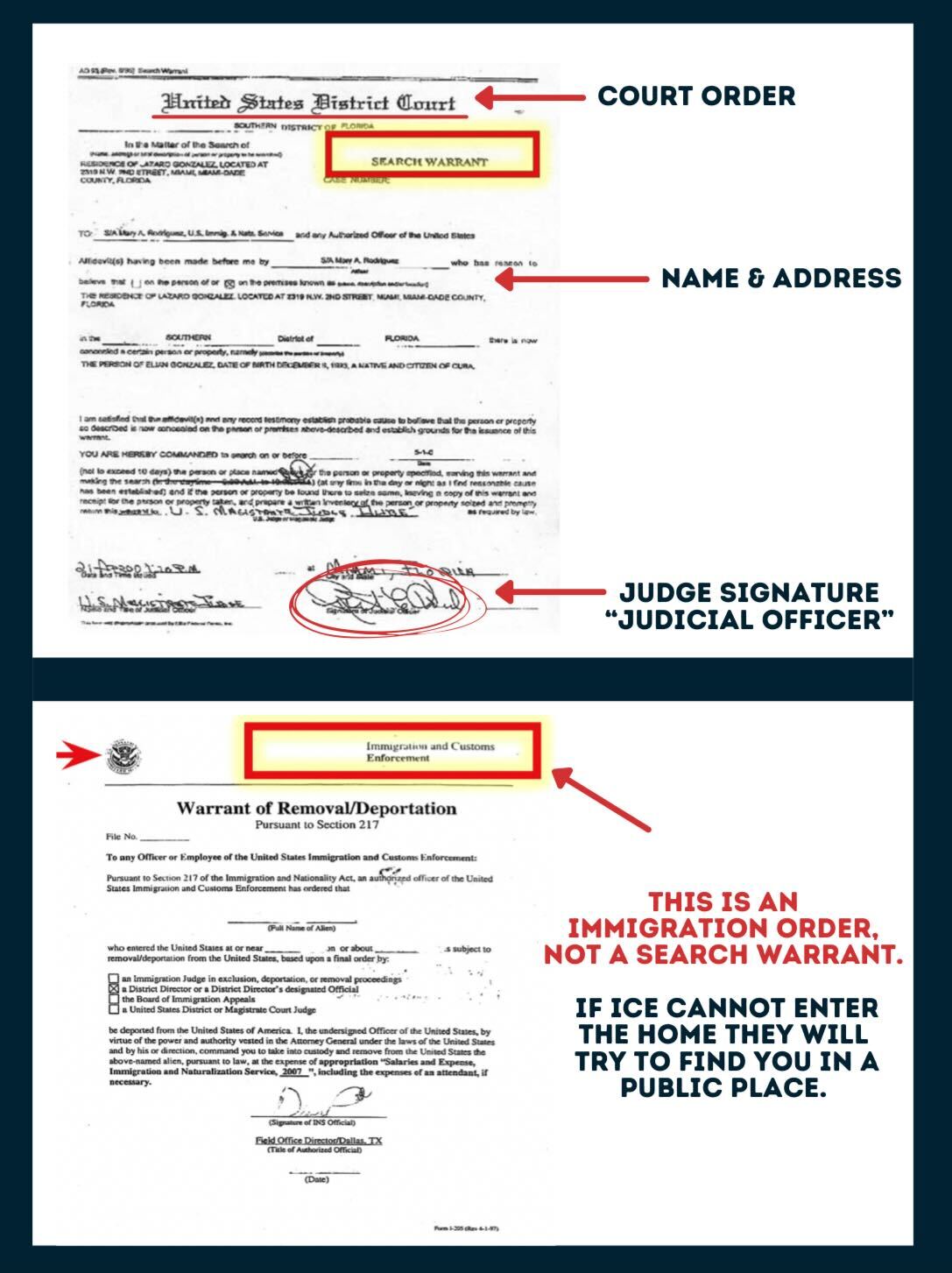
What does a legal warrant look like?
Know what a legal warrant looks like. The top image shows a legal judicial warrant with the information required for a legal search.
The bottom image is an immigration order, which ICE often tries to use, but if you know your rights, you know that this type of warrant does not have enough information for a legal search.
Know your rights: You have the right to stay quiet, to ask for a lawyer, and to ask to see a warrant.
Carry a Know-Your-Rights card with you. This card can help you show the police or immigration officers that you know your rights.
Make an emergency plan for your family: Know important phone numbers (like a lawyer or emergency contact), make sure there is someone to take care of your children if you are taken, and keep important papers in a safe place at home.
Keep your ID safe: Know which identification papers you should carry. Don’t carry fake IDs or documents from other countries, because that could make things worse.
Make sure your family can find you if you are taken. They can use the ICE detainee locator to find where you are. It helps if they know your A-number (if you have one).
It may be stressful to think about facing immigration raids or detentions. Practicing somatic centering can help you stay grounded and connected to your strength in moments of high stress. Even a simple breathing or centering practice can help you return to yourself and make clearer decisions in the moment. Watch our video for more tips on centering.
For more information about your rights and what might happen in an immigration raid, arrest, or detention, you can check out the Immigrant Defense Project‘s resources.
 Know what a legal warrant looks like. The top image shows a legal judicial warrant with the information required for a legal search.